
Factors Affecting Fan Efficiency
Fan efficiency is a critical performance metric that reflects how effectively a fan converts electrical input power into useful aerodynamic energy. It is typically calculated as the ratio of output power to input power. Higher efficiency directly contributes to lower energy consumption, reduced operating costs, and improved overall system performance.
Below are the major contributors to fan efficiency.
1. Structural Design Factors
Impeller Type and Design
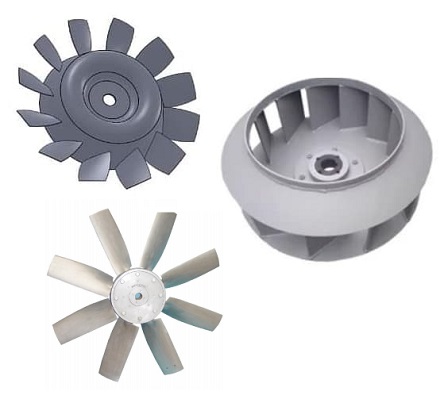
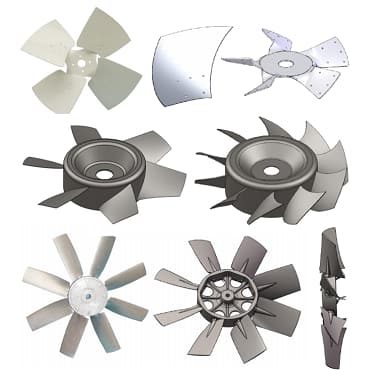
Different fan types—such as centrifugal fan, axial fan, and mixed flow fan—have inherently different aerodynamic efficiencies. Moreover, the shape, number, and angle of the blades, as well as the design of the inlet and outlet, significantly influence airflow behavior and energy conversion.
Casing and Scroll Design
The gap between the fan casing and impeller must be carefully controlled. Too large a clearance can lead to internal leakage and lower efficiency. The shape of the scroll (volute) also affects how well the airflow is collected and discharged.
Inlet and Outlet Conditions
Restricted airflow at the inlet or outlet, due to abrupt duct transitions or tight bends, can increase system resistance, reducing the overall efficiency of the fan.
2. Operating Parameters
Flow and Pressure Matching
Fans achieve their highest efficiency at the Best Efficiency Point (BEP). Operating away from BEP—either underloaded or overloaded—can significantly reduce performance due to turbulence, stall, or flow separation.
Rotational Speed
Fan performance is a function of speed. Both too high and too low rotational speeds can deviate the system from optimal operation. Speed variations affect airflow and static pressure, thereby influencing efficiency.
3. Motor and Transmission System
Motor Efficiency
The efficiency of the electric motor itself plays a critical role. Motors classified as higher effeciency level significantly enhance total fan system efficiency.
Transmission Type
-
Direct drive systems offer the highest transmission efficiency.
-
Coupling drives are moderately efficient.
-
Belt drives typically result in several percentages of energy losses due to belt slip and transmission friction. Poorly tensioned belts further reduce efficiency.
4. Manufacturing Precision and Balancing
Dynamic and Static Balancing
Imbalanced impellers cause vibrations, leading to mechanical energy loss and decreased fan efficiency. Fan balancing is one of the critical processes of quality control.
Manufacturing Quality
Low precision, excessive gaps, or poor surface finishing can introduce aerodynamic and mechanical losses.
5. Installation and Operating Environment
Installation Practices
Improper alignment, absence of vibration isolators, or poor duct connections can cause vibrations, airflow disruption, and energy waste.
System Resistance
Excessive system resistance from filters, dampers, or ductwork can push the fan far from its BEP, reducing its aerodynamic efficiency.
6. Control Strategy
Use of Variable Frequency Drives (VFDs)
VFDs allow speed modulation, enabling the fan to operate closer to its BEP across different load conditions, significantly improving part-load efficiency.
Constant-Speed Operation
Running at fixed speeds often leads to oversupply or undersupply of airflow, necessitating dampers to control output—resulting in unnecessary energy loss.
7. Maintenance and Upkeep
Bearing Lubrication and Shaft Alignment
Poor lubrication and misalignment increase friction, reduce efficiency, and accelerate component wear.
Blade Contamination or Corrosion
Dust accumulation, debris, or corrosion on blades alters aerodynamic profiles, causing turbulence and efficiency loss.
Electrical Issues
Overheating, under-voltage, or unstable power supply can lower the motor’s operating efficiency and affect overall performance.
Summary
Fan efficiency is determined by the product of:
Fan aerodynamic efficiency × Motor efficiency × Transmission efficiency
Therefore, improving fan efficiency requires a holistic approach that includes:
-
Optimized fan design and selection
-
High-efficiency motors and transmission
-
Intelligent controls like VFDs
-
Clean and aerodynamically efficient ductwork
-
Proper installation and regular maintenance
By focusing on these dimensions, users can expect reduced energy costs, improved system reliability, and compliance with international energy efficiency regulations.
Note: The content of the article cannot avoid omissions and errors. Welcome to propose corrections.
 Libere el poder del ventilador de gabinete
 Ventilador axial industrial: Cómo mantener una circulación de aire adecuada
 Ventilador de ventilación industrial: manteniendo una buena calidad del aire
 Ventilador a prueba de explosiones: garantizando la seguridad en entornos peligrosos