
Sound Attenuation Differences Between Cabinet Fan and Axial Fan
Industrial and commercial ventilation systems are increasingly required to meet strict acoustic performance standards, especially in enclosed spaces like underground car parks, subway tunnels, shopping malls, and office buildings. One of the major challenges faced by engineers and ventilation system designers is fan-generated noise. While both cabinet fans and axial fans are widely used in modern ventilation systems, their methods of sound attenuation differ significantly due to their structure and application. Below discussing the differences for right fan selection with optimal acoustic performance.
1. Why Fan Noise Matters in Industrial and Civil Applications
Noise generated by ventilation systems can lead to regulatory non-compliance, lower comfort levels, and even operational safety issues. Fan noise generally originates from:
-
Mechanical vibrations of motors or blades
-
Turbulent airflow
-
Structural resonance
-
Motor-housing airflow interactions
The selection of the right fan type and noise mitigation strategy depends on the fan’s design and where it is installed. For instance, in road or subway tunnels, jet fans must operate with minimal acoustic interference, while in office buildings, low-noise cabinet fans support comfort and energy efficiency.
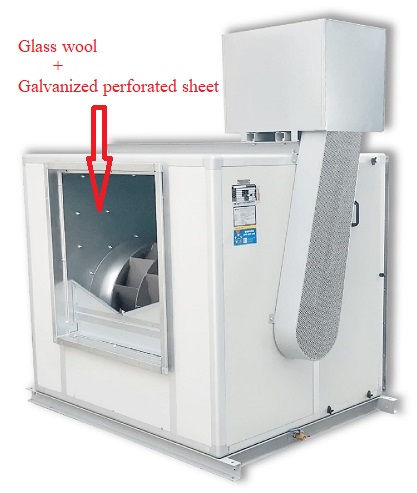
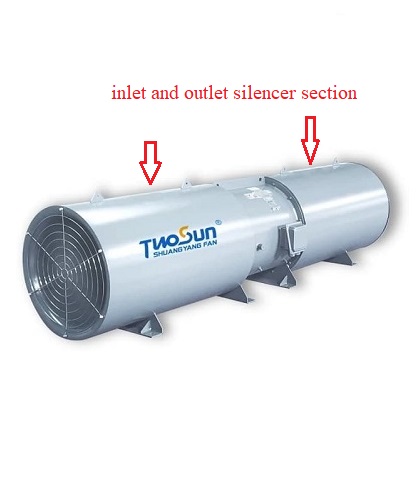
Fig 1. Sound Attenuation of Cabinet Fan - (Glass wool + Galvanized perforated sheet) Fig 2. Sound Attenuation of Jet Fan (a special type of axial fan) - (inlet and outlet silencer section)
2. Cabinet Fan: Integrated Soundproofing Inside the Housing
A cabinet fan, also known as a box fan or packaged fan, is characterized by its enclosed structure. Its box-like housing allows significant flexibility in integrating acoustic insulation materials directly inside the unit. Here's how it works:
a. Internal Acoustic Lining
Cabinet fans typically feature sound-absorbing foam or acoustic panels inside their enclosures. These materials reduce airborne noise and vibrations before they exit the fan. The internal space allows easy lining with fire-resistant and high-density acoustic materials (Fig 1), such as:
-
Glass wool
-
Melamine foam
-
Perforated sheet + acoustic infill combinations
This approach absorbs mid- to high-frequency sound waves generated by the impeller and motor.
b. Anti-vibration Mounting
Cabinet fans are often mounted on anti-vibration pads or springs, further reducing structural-borne noise transmission.
c. Flexible Application Scenarios
Thanks to their quiet operation, cabinet fans are frequently used in:
-
High-end office buildings
-
Schools and hospitals
-
Museums
-
Commercial HVAC systems
The acoustic treatment is built into the unit, making installation cleaner and more space-efficient.
3. Axial Fan: External Silencers Are a Necessity
In contrast, axial fans, especially those used in high-volume applications like tunnel ventilation or emergency smoke extraction, have limited space for internal sound attenuation. The structure of an axial fan is linear and open, making external silencers the primary method of noise reduction.
Silencer Sections at Inlet and Outlet
To control noise, axial fans require silencer segments (attenuators) mounted at the fan inlet and outlet. These silencers are usually filled with high-performance acoustic media like mineral wool, allowing airflow while damping noise.
For example, in tunnel applications, jet fans (a special type of axial fan) use long silencer sections on both ends (Fig 2).
4. Conclusion
Sound attenuation is not a one-size-fits-all solution in the fan industry. Cabinet fans and axial fans differ in how they handle acoustic control. Cabinet fans benefit from internal insulation, making them compact and acoustically optimized by design while axial fans rely on external silencers.
When designing a ventilation system for your project, consider not only airflow and pressure but also the acoustic integration strategy that best fits your application.
For technical consultation or customized ventilation solutions, please contact us SHUANGYANG FAN, a trusted manufacturer of high-performance fans for tunnels, subways, industrial plants, and commercial buildings.
Note: The content of the article cannot avoid omissions and errors. Welcome to propose corrections.
 Libere el poder del ventilador de gabinete
 Ventilador axial industrial: Cómo mantener una circulación de aire adecuada
 Ventilador de ventilación industrial: manteniendo una buena calidad del aire
 Ventilador a prueba de explosiones: garantizando la seguridad en entornos peligrosos