
Brief Introduction of Industrial Centrifugal Fans
1. Introduction
Industrial centrifugal fans play a vital role in diverse sectors—HVAC systems, manufacturing, dust collection, chemical processing, and more—where they transfer air or gas under pressure. Their rugged design, ability to generate high static pressures, and adaptability to harsh environments make them indispensable.
2. What Defines Industrial Centrifugal Fans?
Centrifugal fans work by accelerating air outward via a rotating impeller, converting kinetic energy into pressure energy within a scroll or housing. This action allows them to generate airflow perpendicular to the intake axis.
Unlike axial fans, which deliver high volume at low static pressures, centrifugal fans are suited for applications requiring both moderate-to-high airflow and pressure.
3. Varieties of Centrifugal Fans
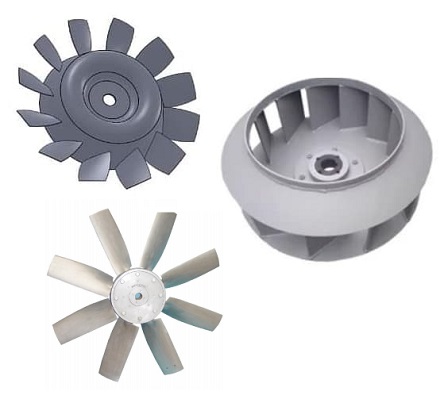
a. Forward-curved – Compact, low to medium pressure fans, ideal for clean-air HVAC applications.
b. Backward-inclined/curved – Highly efficient, moderate to high pressure fans, suitable for many industrial uses.
c. Radial-blade – Handle dirty or particulate-laden airstreams in heavy-duty environments.
d. Airfoil – Aerodynamic blades delivering quiet, efficient airflow in cleaner industrial conditions.
4. Performance & The Fan Laws
Affinity Laws:
- Flow (Q) ∝ RPM
- Pressure (P) ∝ RPM²
- Power (HP) ∝ RPM³
Using these laws, changing fan speed via VFDs enables precise airflow control and energy savings.
CFM and Static Pressure:
Fan performance is plotted on a curve of CFM (cubic feet per minute) vs. static pressure.
Efficiency:
Understanding impeller design impact and selecting the best blade type minimizes energy loss. Proper component design reduces skin friction and turbulence.
5. System Efficiency
System Effect: Real-world conditions—ductwork bends, inlets/outlets, filters—can reduce fan performance vs. lab conditions. Proper layout and inlet design are essential to mitigate these losses.
Fan Energy Index (FEI): FEI benchmarks help compare fans’ energy use under real conditions. Higher FEI fans yield long-term cost savings.
Sizing for Efficiency: Oversizing fans leads to inefficiency, noise, and maintenance issues. A system-level design approach ensures quieter, more efficient and reliable operations.
6. Basic Formula: Estimate Fan Power
A simplified calculation for estimating horsepower required:
-
Q = airflow (CFM)
-
ΔP = pressure rise (in. w.g.)
-
η = fan efficiency
229 = conversion constant (from CFM×in w.g. to HP)
7. Use Cases of Industrial Centrifugal Fans
Dust Collection & Material Handling: Radial fans in baghouses and pneumatic conveyors manage dusty or hot gas with efficiency.
HVAC & Building Ventilation: Airfoil and backward-curved fans are widely used in air-handling units, fume hoods, and clean-room systems.
Process Cooling: Fans integrated into dryers, ovens, and heat exchangers maintain environmental stability.
High-Pressure Applications: Booster fans elevate static pressure for pressurized pipelines and pneumatic systems.
8. Maintenance & Longevity
- Regular inspection of bearings, belts, and impellers prevents performance decay.
- Keep housings clean and free from debris.
- Lubricate as per manufacturer guidance to avoid heat build-up.
- Check alignment and vibration levels to detect early wear.
9. Summary
Industrial centrifugal fans—with choices from forward-curved to radial and airfoil styles—offer robust, adaptable ventilation and process air movement. Through an informed choice of blade type, sizing, and speed control, combined with system-wise layout and maintenance practices, organizations can boost energy efficiency, reduce downtime, and extend equipment life.
Read more:
→ Click for the animation video of introduction of industrial centrifugal fans.
→ Click to learn some of our industrial centrifugal fans products.
Note: The content of the article cannot avoid omissions and errors. Welcome to propose corrections.
 Libere el poder del ventilador de gabinete
 Ventilador axial industrial: Cómo mantener una circulación de aire adecuada
 Ventilador de ventilación industrial: manteniendo una buena calidad del aire
 Ventilador a prueba de explosiones: garantizando la seguridad en entornos peligrosos