
Industrial Axial Fan: Maintaining Proper Air Circulation
1. Introduction
In construction sites, warehouses, manufacturing plants, and fire protection systems, maintaining proper air circulation, temperature control, and safety depends heavily on well‑engineered industrial axial fans. These robust machines are designed to move large volumes of air at relatively low pressure, delivering ventilations, cooling, and contaminant extraction where it matters most.
2. What Is an Industrial Axial Fan?
An industrial axial fan consists of a rotating hub with multiple blades, enclosed within a cylindrical housing. Air moves parallel to the fan shaft—entering one side and exiting directly out the other—making them ideal for high-volume, low-pressure applications.
These fans come in direct-drive and belt-driven forms, including vane-axial types with adjustable blade pitch, offering design flexibility.
3. Core Advantages
High Volume Air Movement
Industrial axial fans are built to circulate massive airflows—ranging from hundreds to millions of cubic feet per minute—within factories, tunnels, and large spaces with ease .
Energy Efficiency
Because they displace air in a straight pass, these fans operate efficiently at low static pressures—delivering more airflow per watt than many other fan types.
Compact Integration
Their cylindrical design and ability to fit tight dwellings makes them suitable for architectural, mechanical ventilation, and fire-safety installations.
Cost-Effectiveness
Operating costs are lower due to energy efficiency and simplified installation. Their design enables easy maintenance thanks to fewer moving parts.
4. Key Applications
Industrial axial fans feature across multiple domains:
-
Building ventilation: Roof or wall-mounted units tackle stale air, humidity, and temperature stratification.
Industrial workshops/factories: Extract welding fumes, dust, and process heat.
-
Fire protection: In fire-rated ducts, axial fans sustain pressurization and safe egress routes.
-
Cooling towers & HVAC: Move air across heat-exchange surfaces.
5. Design Formulas
5.1 Fan Laws ("Affinity Laws")
Key relationships include:
where is volumetric flow, the pressure rise, shaft power, and speed. These guide variable speed drive (VSD) tuning and system scaling.
5.2 Fan Power Equation
Power required:
where is fan efficiency. Increasing pressure or flow raises power demand.
6. Conclusion
The industrial axial fan is a cornerstone of modern ventilation, cooling, and fire protection infrastructure. With scalable airflow, high efficiency, and flexible design, these fans meet rigorous operational and regulatory demands.
Read more about SHUANGYANG FAN Solution
Note: The content of the article cannot avoid omissions and errors. Welcome to propose corrections.
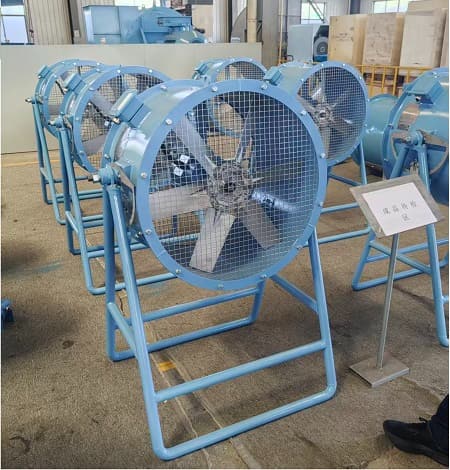 Mancooler (Workstation) Fans — Why Your Factory Needs the Right One
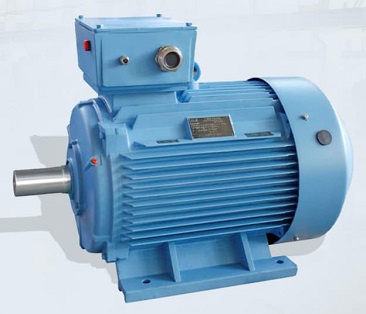 Motor Classifications in Industrial Fans
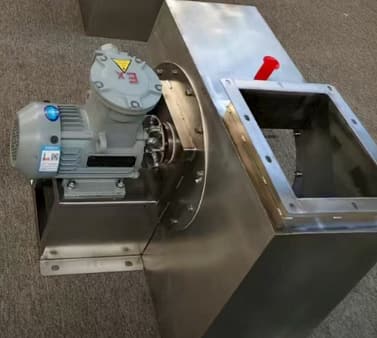 Materials for Explosion-Proof Fan
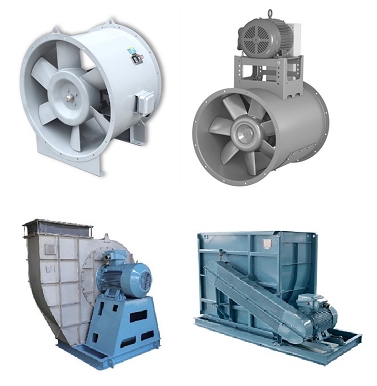 Direct Drive vs. Belt Drive in Axial Fan and Centrifugal Fan