
Inline Fan: Essential Component in Ventilation & Smoke Exhaust
Inline fans are duct-mounted devices integral to modern HVAC and smoke exhaust systems in commercial buildings, industrial workshops, subways, and nuclear-grade installations. Installed in-line within the ductwork, they directly enhance airflow without requiring wall or ceiling penetration—ideal for long duct runs or complex layouts. Inline fans are highly modular, compact, and flexible, making them perfect for various applications.
1. Inline Axial Fan: High‑Volume, Low‑Pressure Workhorses
Working Principle & Design
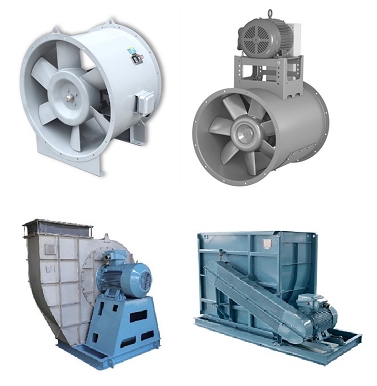
An inline axial fan pushes air straight along the axis—blades spin in the direction of airflow, creating low-pressure, high-flow output. These fans usually have 2 to 6 blades and operate at relatively higher peripheral speeds.
Key Features
-
High airflow with low static pressure – perfect for ventilating large, open spaces like commercial malls or industrial halls .
Compact, lightweight design – easy to install in duct systems with minimal structural reinforcement.
-
Energy-efficient and cost-effective – fewer blades and simple casing keep costs and power usage low.
Typical Applications
Inline axial fans are commonly employed in:
-
General ventilation spaces (retail malls, multi-story commercial buildings)
-
Tunnel ventilation (e.g., metro tunnel fans)
-
Industrial cooling of machinery or electronics
-
Smoke exhaust systems in kitchens, stairwells, and smaller smoke zones
2. Inline Centrifugal Fan: Pressure Champions with Precision
Working Principle & Design
An inline centrifugal fan draws air into its impeller hub and discharges it radially (typically at 90°) through casing. These fans are duct-mounted but operate using centrifugal force to achieve high static pressure.
Key Features
High static pressure capability – enables airflow through extended duct networks, filters, dampers, or multiple bends.
Robust performance under challenging conditions – suitable for fume extraction, high-temperature or corrosive environments.
-
Quiet and stable operation – backward-curved or airfoil impellers reduce noise and vibration.
Typical Applications
Common uses include:
-
Smoke control in large spaces (roof fans in atria and stairwells)
-
Ventilation in industrial plant settings (dust collection, chemical/thermal processes)
-
HVAC systems in nuclear-grade fans or clean rooms
-
Exhaust in manufacturing lines, workshops, and pollutant control systems
3. Choosing Between Inline Axial & Centrifugal Fans
A quick comparison highlights when each type fits best:
| Feature | Inline Axial Fan | Inline Centrifugal Fan |
|---|---|---|
| Airflow Volume | High | Moderate |
| Static Pressure | Low | High (handles duct resistance) |
| Installation Complexity | Simple, compact design | Requires structured housing, heavier mounting |
| Noise Level | Higher at high speeds | Lower (designed for quieter operation) |
| Energy Efficiency | Excellent at low pressure | High (especially with airfoil/blade optimization) |
| Tunnel, general ventilation | Industrial control, long duct runs |
Choose inline axial for large-volume, low-resistance systems (e.g., general ventilation in commercial buildings or metro tunnels).
-
Choose inline centrifugal where duct system pressure is high or long run lengths are required, or for specialized smoke exhaust or industrial processes
4. Engineering Considerations for Inline Fans
Performance Curve
Fan selection requires overlaying the system static pressure curve with the fan's performance curve to locate the operation point (CFM vs. ΔP). Mismatched selection leads to inefficiency or insufficient airflow.
Efficiency & Blade Design
Axial fans benefit from blade element theory to optimize airflow and prevent stall.
-
Centrifugal fans with backward curved or airfoil blades deliver peak efficiency and reduced noise.
Motor & Drive Systems
It's critical to match fan type with motor horsepower and use VFDs (variable frequency drives) for speed control. VFDs enhance energy efficiency and adaptability during off-peak periods .
Durability & Maintenance
-
Bearings: Choose low-vibration, heavy-duty options for continuous operation .
-
Materials & Coatings: Carbon steel or stainless housings paired with hot-dip galvanizing and optional epoxy/polyurethane paint ensure corrosion resistance in harsh environments.
-
Inline axial fans are easier to access and clean; centrifugal units may need more structural support but allow for easy impeller and belt access.
5. Integration Tips for High Performance
Optimize duct layout – minimize bends; include sound attenuators.
-
Proper mounting – isolate vibration through flexible connectors and resilient mounts.
-
Selective blade types – pick backward-curved or airfoil impellers for energy savings.
-
Use VFDs – save energy with variable-speed control tied to building management systems (BMS).
-
Routine maintenance – lubrication, filter cleaning, vibration monitoring, and performance testing—crucial for longevity and safety.
6. Emerging Trends & Innovations
-
Smart fan systems – integration of IoT sensors for real-time performance, airflow, vibration, and predictive maintenance.
-
High-efficiency blade profiles – new geometries tailored for lower noise and higher airflow.
-
Sustainable coatings and materials – eco-friendly, corrosion-resistant coatings for longer service and less environmental impact.
Hybrid inline designs – combining axial and centrifugal features for medium-pressure, medium-flow applications.
Conclusion
-
Inline fans are linchpins of modern ventilation, smoke control, and industrial airflow.
-
Choose inline axial fans for high-flow, low-pressure systems; inline centrifugal fans when static pressure is a factor.
-
Design with precision—evaluate airflow requirements, static pressure, fan curves, energy use, noise, and room layouts.
-
Advanced materials, motor controls (VFDs), and IoT-enabled systems will define the next generation of inline fan installations.
By adopting data-driven design and robust fan selection, your ventilation and smoke exhaust systems will deliver unmatched reliability across commercial, industrial, tunnel, and nuclear environments.
Note: The content of the article cannot avoid omissions and errors. Welcome to propose corrections.
 Mancooler (Workstation) Fans — Why Your Factory Needs the Right One
 Motor Classifications in Industrial Fans
 Materials for Explosion-Proof Fan
 Direct Drive vs. Belt Drive in Axial Fan and Centrifugal Fan